

|
Thursday, May 15, 2003
By STEVE LEVINE
and BERNIE WEISENFELD
Courier-Post Staff
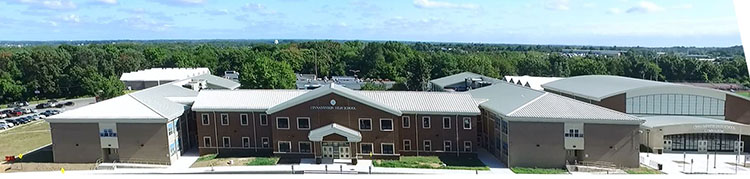
DEPTFORD-Officials broke ground Wednesday on a $14 million expansion
and renovation effort at the Gloucester County Institute of Technology.
The funds, half of which were appropriated by the county in November
and the rest to come from the state, will pay for a new gymnasium and
cafeteria as well as extensive renovations to existing buildings, designed
by Garrison Architects of Mt. Laurel, NJ.
More importantly, officials said, the project will enable the school
to offer full-time scheduling to nearly all of its students. Presently,
about half of the students are full time and the other half are "shared
time," meaning they split hours between GCIT and a hometown school.
Brian Lacort, a senior in the full-time automotive technology program,
said the benefit of not having to shuttle between schools was enormous.
"When you go to a school like this full time it makes you motivated
because you're surrounded by people who like what you do," he said.
Lacort plans to attend Gloucester County College in the fall and transfer
to Drexel University for electrical engineering.
GCIT Superintendent Fred Keating said fire science, law enforcement,
child development and cosmetology will remain shared-time programs,
but students in all of the school's other curricula will go full-time
beginning in September 2004.
"The capital project will expand the facility," he said. "It
will enable us to convert the school to a full-time comprehensive high
school."
The work is part of a plan to double daytime enrollment at the vocational
school to about 1,000.
The Tanyard Road school originally provided shared-time studies for
all students; the program still involves half-day sessions for job training
at GCIT for juniors and seniors, and academic classes like English and
history at the students' home schools.
A move away from shared-time began in 1999 when the first freshmen were
selected for GCIT's regional performing arts academy.
County school officials believed a shared-time format wasted time and
money because of the need to transport students between schools. The
travel makes it more difficult for high school students to complete
state-mandated requirements, they said.
But plans for a more extensive conversion to full-time classes met opposition.
Citing educational and funding concerns, some local school officials
opposed conversion to a full-time GCIT program. As a result, a $10.5
million county government commitment to expanding the school was put
on hold in 1998.
Keating, who became the school's top administrator in 2001, said all
high school superintendents in the county now support GCIT's restructuring.
Full-time, four-year academies will be expanded with the addition of
an allied health careers program next year, joining the full-time performing
arts and business academies, Keating said.
Construction technology and culinary arts programs also will become
full-time in phases over the next four to five years.
Of the $14 million appropriated, just $4.3 million will go to building
the new gym and cafeteria. The remainder is for renovations like energy-efficient
windows, ventilation systems and an elevator for people with disabilities.
|